Click to go to http://www.atada.org/click to go to www.iaca.com
Click to Go To Picklist of Sunshine Studio Pages

Sunshine Studio American Indian Jewelry Gateway Page

Preferred URL - http://www.sunshinestudio.com/American_Indian_Jewelry.html


Welcome to the Sunshine Studio American Indian Jewelry Gateway page. Links to the following jewelry-related pages are provided ,

Google Custom Search of the Sunshine Studio Web Site

Google Custom Search

A Google search of the Sunshine Studio web site can help you find the web page(s) containing art that interests you -  note that Google's database is not as up to date as ours, thus Google may find some items that have already been sold and will not find the most recently posted items. If you wish, you may phone us at 800-348-9273 for personal assistance in finding what you want.


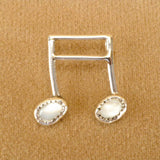
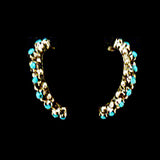
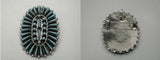
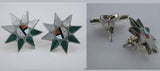
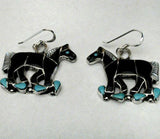
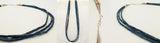
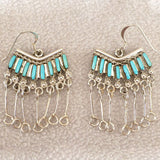
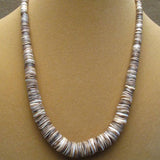
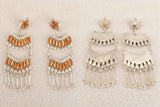
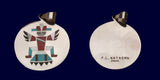
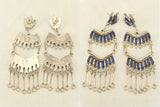
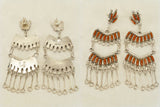
Look no further. You'll find it here at Sunshine Studio, Santa Fe Indian Traders. We have American Indian jewelry including handmade, one-of-a-kind sterling silver and turquoise bracelets, earrings, bolas, concho belts, pins, pendants, necklaces, old pawn jewelry, inlay jewelry, overlay jewelry, heishe, squash blossom necklaces, American Indian Jewelry books, etc. At Sunshine Studio - Santa Fe Indian Traders, you'll discover an easy to use, information packed web site. To learn more about Sunshine Studio, click here. For more on the origins of the Sunshine Studio American Indian Jewelry page, click here. For the origins of Zuni Fetish Necklaces at Sunshine Studio, click here. Or you may click here to learn more about how Indian Jewelry is made.

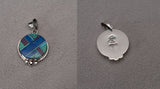
American Indian Jewelry from Sunshine Studio

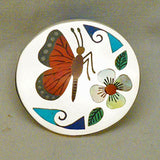
The Sunshine Studio American Indian Jewelry page was started by Challis Thiessen circa 1995. She chose a collection of items spanning the range from inexpensive pins, earrings, and crosses at $19 each to squash blossom necklaces and concho belts over $2,500 each. The age range was from contemporary back to the earliest that could routinely be found, ie the 1920s. You can see her fascination with dragonflies, butterflies, horses and cats in the collection. Her pieces were mostly contemporary as that was what was available. After her death, I continued to fill in the collection replacing pieces as they were sold and adding a few.
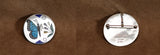
Challis had a message. There are beautiful, American Indian made, one-of-a-kind pieces to choose from at prices comparable to or better than the jewelry being sold in malls, even at the low end.

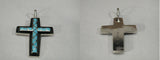
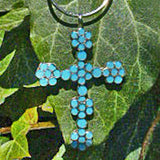
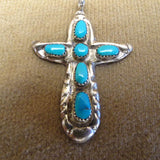
Among the crosses are a number of contemporary pieces from the Iule family, nowadays mostly by the grandchildren of Horace Iule. These are sandcast crosses in which the molten silver was poured into hand carved molds. If they were decorated with coral, silver, or other semi-precious stones, then bezels were hand-formed to the hand-cut stones. The bezels were then soldered to the crosses and the stones were mounted into the bezels, all by hand. The process used today is the same as that used by Horace Iule starting in the 1920s, as illustrated in Rodee and Ostler's book, Zuni: A Village of Silversmiths .

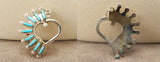
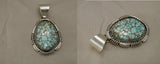
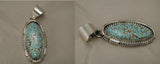
There are many forms of jewelry based on turquoise or coral mounted on silver. These range from large stones on stamped silver from the Navajos, to tiny petit-point dots on finer silverwork by the Zunis. Prices depend strongly on the quality and price of the stones used. These, in turn, depend on what was available in the era in which the jewelry was made. Many different mines around the world have been involved - with Persian turquoise early, American Turquoise over most of the era, and Chinese turquoise more recently. Individual mines have opened and played out throught the era. Most recently, there has been a rush to produce Chinese turquoise since most of the mines will be flooded between now and 2009 as the new Three Gorges Dam becomes fully operational.

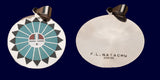
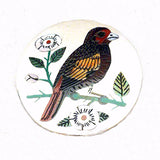
The Zunis have become famous for overlay jewelry, perhaps with popularity exceeding that of petit point at the present time. Zuni inlay started with finely cut stones in the pattern of a figure or geometric design. According to Adair (John Adair, The Navajo and Pueblo Silversmiths, University of Oklahoma Press, 1944, pg. 148), such work was already common in Zuni Pueblo in 1920 at the time of the excavation of Hawikuh, but were prized by the local residents and not sold outside the pueblo. Some pieces of inlay were excavated from much earlier times, so this was not a recent invention. These were mounted on a stone or flat metal backing. Teddy Weahkee claims to have been the first to have asked a Navajo silversmith to mount one of his inlay figures in silver for sale in the trade in 1934 as reported in an interview in The Gallup Independent. By 1940, such inlay was quite common. There are now two forms of inlay, stone on stone and channelwork inlay. Stone on stone was the earliest form. In recent years, stone on stone has been developed into a highly precise form, with thinly cut stones fit into a silver overlay backing (similar to Hopi channelwork) with no more tha a few thousandths of an inch gap between stones and the silver backing. Figures include very ornate birds and animals as well as traditional Zuni Kachinas. Artists such as Dennis and Nancy Edaakie, Rudell and Nancy Laconsello, and the Guardians, are perhaps the best among many. Channelwork inlay has thin silver channels between the stones. This form became popular in the 1940s. Numerous Zuni artisans make use of this form. There are also hybrids, with several pieces of stone on stone inlay in groups set in channelwork. Challis' first piece of Zuni inlay was a Dennis Edaakie roadrunner in silver with triangular border purchased circa 1968.

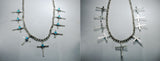
Challis' first contact with fetishes was with fetish necklaces. During the boom of the late 1960s and early 1970s, she collected several Dinah Gasper and Tsikewa family necklaces. She loved the fine detail of these necklaces, and seemed to treasure one or two strand necklaces in which the detail of the fetishes is most apparent. Other people favor three to ten strand necklaces for the splash of color that can be obtained when many properly bibbed strands are worn together. Some years afterward, she began to purchase table fetishes. Only later were we to learn that there were a very few table fetishes made in the 1950s and 1960s, but when the market for jewelry went sour in the mid 1970s, the fetish carvers who were previously carving fetishes for necklaces began to carve larger table fetishes that could be sold for higher prices per fetish. Lavina Tsikewa continued to carve fetishes for necklaces, but had to reduce her prices to continue to sell them. Challis proudly made available necklaces by Lavina Tsikewa, Lena Boone, and Dinah Gasper. When she died in 2003, Challis had quite a few fetish necklaces available, but which were not posted on the web. I am in the process of cleaning up and organizing the collection and making some more of her necklaces available for sale.

I have reorganized the jewelry pages with better photos and descriptions. I will continue to improve the photos as time permits. I present here Challis' eclectic jewelry collection reorganized for your enjoyment.

Arch Thiessen, 29 May 2007.


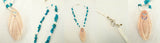
Zuni Fetish Necklaces from Sunshine Studio

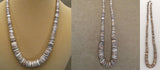
Challis' first love in American Indian art was Zuni Fetish necklaces. She started collecting fetish necklaces in the late 1960s. She loved every detail - every individual fetish, every stone, and every carver. When possible, she would pick out the fetishes, go to Santo Domingo to find heishe, and string the necklaces herself.

After the boom of the 1970s was over, Challis bought up many traders' last stocks of fetishes when she could find them. She began to string more and more of them herself. But not many necklaces were being sold and there was not a lot of activity.

In the 1980s, the carvers began to understand that there was a market for table-sized fetishes, and larger and larger fetishes by the fetish necklace carvers including Lena Boone and the Gaspers appeared on the market. Table fetishes began to be made in more colorful materials, whereas earlier they were mostly done in serpentine and jet. At his time, 'realistic' table fetishes appeared as well and the reputations of carvers including Dan Quam and Lance Cheama were made.

In the 1990s, the traditional carvers of fetishes for necklaces began to string the necklaces themselves, and loose fetishes drilled for stringing are no longer available. Unique styles of necklaces appeared, such as the Quandelacy necklaces strung on double strands of coral. But in the market, there was a greater demand for table fetishes than for necklaces.

In 1995, we established Sunshine Studio. Business picked up, and most of our sales were in table fetishes. Challis did not have time for stringing, and although we had a few necklaces on the web site, not many were sold. Most of Challis' necklace sales were at shows or to acquaintances by 'word of mouth.'

After Challis' death, I decided to post the remaining necklaces that she had for sale. The few remaining loose fetishes and strands of heishe have been strung. I chose to fill in the sales inventory, and purchased a few necklaces myself. Gradually I built up the fetish necklace page. I will continue to add a few carvers as time and money permit.

Today, almost all carvers string the fetishes into necklaces themselves. The market for fetish necklaces is small, but there is a steady demand for necklaces which seems to be growing. We present here a sample of the many necklaces that can be found on today's market. There are some carvers represented here whose first necklaces were made as special orders for Sunshine Studio. Challis loved all of them. We hope you do too.


Sunshine Studio, a small home-based business located in Santa Fe, New Mexico, has been in business since 1970, on the Internet since 1995, and is a member of ATADA, Antique Tribal Arts Dealers' Association, Inc. Buy, sell, or trade, you will be satisfied with any deal you make with us. Our Guarantee: We will accept the return of any item for full refund within 10 days if returned in its original condition, no questions asked. Shipping and insurance charges are the responsibility of the customer. For more information, check our Ordering Information.

Click on images to see an enlarged version. If you do not see what you want on this page, ask us or try a special order.

e-mail: sunshine@sunshinestudio.com request more information or to provide feedback

Directory of Fetish-Related Pages: Fetish2.html


Click on any Link Below to Go to any Active Sunshine Studio Page

American Indian Jewelry | Christmas Folk Art | Cyber Life |  Hopi Kachinas | Jewelry Books | Zuni Jewelry | Jewelry Earrings | Concho Belts | Crosses

Pueblo Paintings  | Pueblo Pottery | Zuni Fetishes | Zuni Indian Fetishes | Zuni Fetish Books | Zuni Fetish Necklaces

 Home Page | Links | Special Orders | What's New

American Indian Beaded Jewelry | American Indian Contemporary Jewelry | Native American Indian Jewelry |
Native American Beaded Jewelry


E-mail problems have been occurring more and more frequently lately. If you have trouble contacting us by e-mail, please feel free to phone us at 1-800-348-9273 or 505-984-3216. Conversely, please be sure that your spam filter is set to accept messages from sunshine@sunshinestudio.com, arch87506@sisna.com, and Sunshine_Studio@email.admail.net . Please also provide us with a phone number that we may use to contact you in the event that e-mail does not work .


This WWW page and all referenced images are Copyright © 1995-2008 by Sunshine Studio - Santa Fe Indian Traders, Santa Fe, New Mexico, USA, or by the artist. All rights reserved. Sunshine Studio is a full member of the Antique Tribal Art Dealers Association, Inc.(ATADA), and the Indian Arts and Crafts Association (IACA). Last modified on 06-Feb-08 by Arch Thiessen, Sunshine Studio Webmaster.

Click for Santa Fe, New Mexico Forecast